BC involuntary care policy found unconstitutional
Post Facto: Police at Pride. Vic seeks more homelessness info. Protest coverage lawsuits. Losing housing.

Judge tosses parts of BC involuntary treatment regime
The BC NDP’s incarceration and forced treatment of substance users and others has been criticized by drug user groups, civil liberties advocates, mental health experts — and now, the BC Supreme Court.
Last Tuesday’s decision declared that key parts of the Mental Health Act (MHA) “unjustifiably infringe upon the rights to life, liberty, and security,” and the equality, of citizens with mental health disorders.
The MHA — which turns 30 this year — allows anyone medical authorities deem “a person with a mental disorder” to be forcibly hospitalized as an “involuntary patient.” And a facility’s director can then force them into psychiatric treatment including medications.
“The right to determine what shall, or shall not, be done with one’s own body, and to be free from non-consensual medical treatment, is deeply rooted in our common law,” declared BC Supreme Court Justice Lauren Blake.
Court specifically overturns “arbitrary,” sweeping, and unaccountable powers of medical directors
Blake said directors are “automatically granted a blanket power,” not just powers in “certain narrowly defined circumstances” when forced treatment may be necessary.
She also said it limits consent rights in a way that “reinforces, perpetuates, and exacerbates historical disadvantage experienced by individuals with a mental disorder.”
Blake gave the province 6 months to fix its legislation.
In response, a BC’s Attorney General spokesperson told CBC that “involuntary care is an important part of mental health care systems across the country.”
But Blake said BC “is an outlier” as the only province giving treatment facilities “unilateral power” to automatically assume some patients are incapable of consent without any assessments, and has no oversight of such powers.
Charter challenge was launched in 2016 by Council of Canadians with Disabilites
The challenge decried citizens being “treated by force” simply because of a mental health disorder, “even if capable of making their own treatment decisions,” per the group’s website.
“This approach reinforces harmful stereotypes by equating mental illness with being incapable,” the CCD argued. “Everyone, including people with mental disabilities, deserves the right to control their own health care.”
Before this case was finally heard, CCD had to fight BC in Canada’s highest court just to represent disabled people at all.
The BC Supreme Court initially agreed with the province that CCD didn’t have legal standing in the case, despite being the country’s largest disability rights charity. But in 2022, Canada’s Supreme Court sided with CCD — and ordered BC to pay its costs.
The CCD has been represented by the Community Legal Assistance Society (CLAS) and McCarthy Tétrault law.
“Everyone with involuntary status is ‘deemed’ to consent to all forms of psychiatric treatment,” CLAS wrote, even electroconvulsive therapy.
One of CLAS’s clients, whose identities are all protected by publication bans, recounted: “My clothes were stripped off me and I was pinned down by 4 male security guards while someone injected a needle into my backside. I was not given any say in my treatment, and even my mom was not allowed to make decisions for me.”
Justice Blake agreed with the plaintiffs that the laws “eliminate the health care consent rights of all involuntarily admitted patients” regardless of their capacity, “contrary to the principles of fundamental justice.”
De Facto will keep following this topic and we welcome any tips to investigate, or sources who’ve experienced the MHA regime directly.
3 months of De Facto!
We launched on International Workers' Day back in May, and we continue to be blown away by the support we've received. We now have nearly $6,000 in total contributions and another $5,000 expected for the year ahead thanks to 90% of our Defactors pledging recurring gifts. Thank you!
If you're a financial contributor, you'll receive a special message soon. If you aren't, donate monthly or yearly to get it.
Ex Facto
Stories we're reading on policing, homelessness, freedom-of-information, legal battles, and other subjects we cover.
Victoria wants more current, detailed information on unhoused residents
Council voted unanimously to push for a faster region-wide rollout of the federal Homeless Individuals and Families Information System (HIFIS), a shared data system that collects what people say about what they need and how they lost housing.
The motion began as a call for a “by-name list” (BNL) with personal profiles of every person currently without a home in the city. That motion from Councillor Krista Loughton, who directed a 2016 documentary on local homelessness, was then amended to focus on HIFIS.
The Capital Regional District has been slated to get HIFIS for years; Councillor Jeremy Cardona blamed delays on the system's complexity but also “bureaucratic ineptitude,” and lack of data sharing by BC Housing.
Victoria has typically measured homelessness with Point-in-Time (PiT) counts: single-night snapshots taken every 2 years. The latest tallied 1,749 people in March 25-26th, 2025. The federal government is now collecting PiT numbers every year, with detailed surveys added every 3.
A lawsuit over media coverage of campus Palestine activism begins, while another ends
The Grind facing $1.3M suit from IDF reservist soldier
A man seen on video removing protesters from a 2025 event at Toronto Metropolitan University claims he was defamed by the independent Toronto publication’s coverage. The Grind twice sought comment from the man, and offered to look into and correct any error, but stood by its reporting. It now seeks help with the legal fight.
National Post admits it defamed professor who protested for Gaza
Meanwhile, New Brunswick prof Jeff Houlahan has dropped his lawsuit against the right-wing outlet after it paid $3,500 and added a long note to its 2025 article about his and other activists’ attempt to travel to Gaza. That note acknowledges that in 2024 he had not “spent weeks … ignoring an eviction order” against a protest encampment at UNB, as claimed, but in fact his union had won the withdrawl of UNB security’s tresspass notice and formal recognition of his right to protest. [NB Media Co-Op / LJI]
Tenants plan legal action against Vancouver after affordable apartments rezoned
Myron Manor's rentals units go for as little as $1,300 for a 2 bedrooms, and replacing them with "tech hotel" rooms loses tenants their usual right to return under the Broadway Plan. Councillor Rebecca Bligh said, in voting against the ABC party majority, that if evicted families are “having to come up with an extra thousand dollars a month, that risks homelessness.”. [Vancity Lookout]
 Maddi Dellplain, Local Journalism Initiative Reporter, Vancity Lookout
2,000+ Quebec households faced homelessness last month
July 1 is Canada Day in most of the country, but Moving Day in Quebec as over 100,000 leases expire. Since 2019, the number of people with no new lease lined up for July has tripled — while Montreal asking rent has doubled, per one rental report. [The Rover]
 Christopher Curtis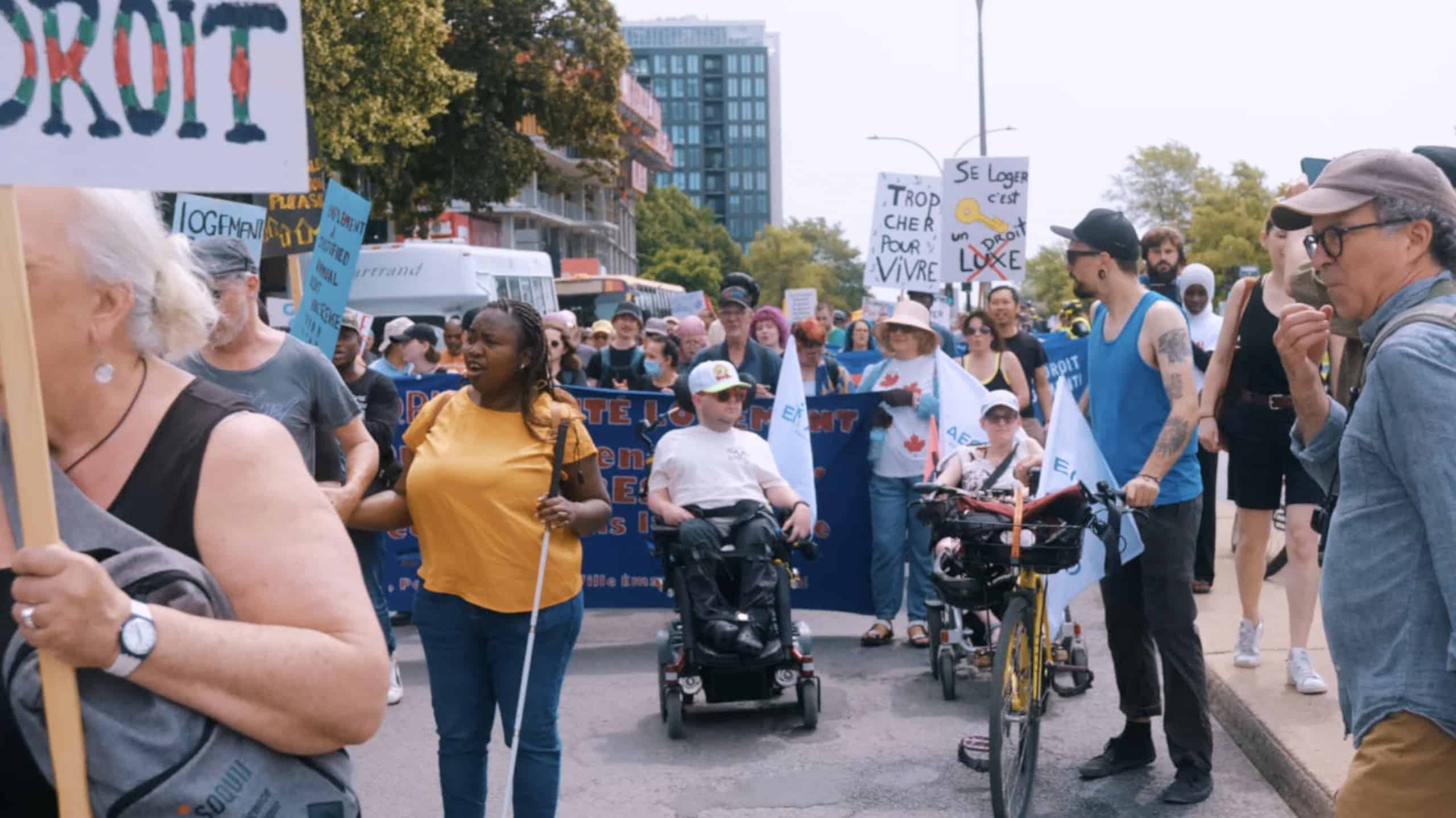
More news:
- Edmonton police never made a report on hit-and-run, and publicized wrong car, says man whose injuries have cost him his job and sense of smell. [The Tyee]
- Anishinaabe of Lac Simon suing Quebec ministry over open-pit gold mine near reserve, saying constitutional consultation obligations weren’t met. [Pivot]
- Richmond encampment designated “hazardous” site after fire that consumed trailers near Highway 99, but was escaped by the occupant and her cats. [Global]
- Police march in Vancouver Pride for first time since removal in 2020; a vendor says organizers gave unclear answers for months about police involvement. [CBC]
De Audio
You can now listen to the Canadian healthcare panel that De Facto's Brishti Basu hosted for PressProgress as a podcast. She also recently covered the end of BC's longest nursing strike.

Thank you for supporting independent journalism that boldly shines a light on law, justice, and rights!