How Vancouver police turned against DULF
Court records show the same inspector who encouraged the compassion club’s founders also approved the investigation that led to raids on their homes
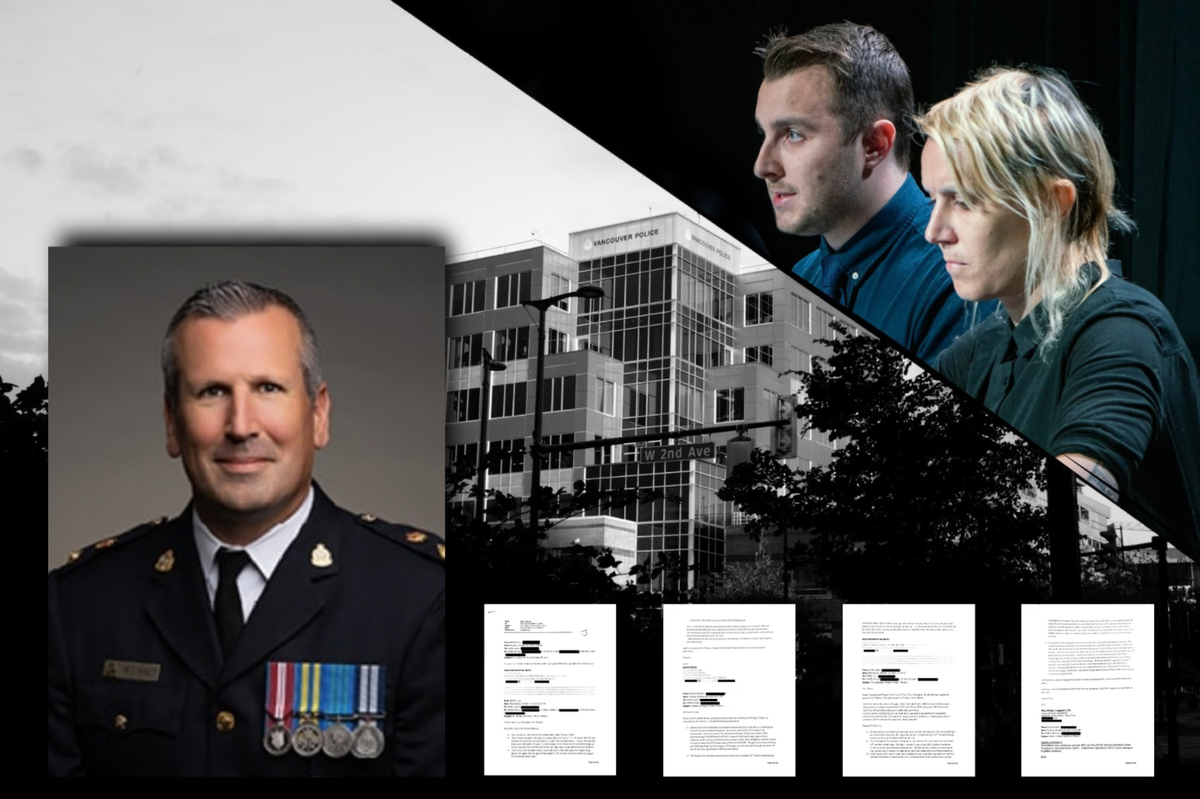


A decision is due tomorrow in the historic constitutional challenge brought by the Drug User Liberation Front founders. Today, we look inside the convoluted police investigation that led to it.
“It’s all a big lie.”
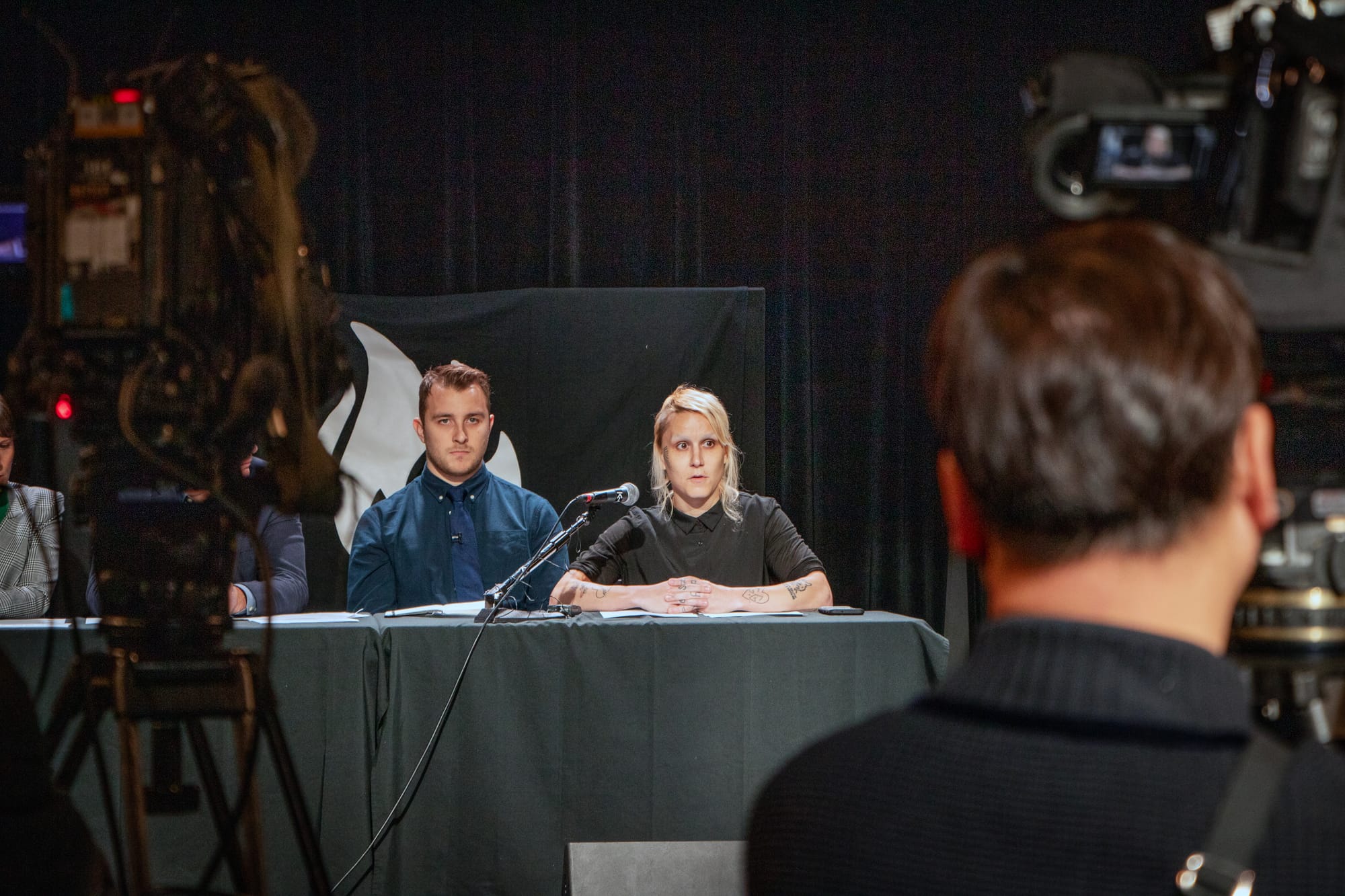
Those five words, spoken by Eris Nyx as sirens wail in the background, open the recording of an August 2021 conversation with two Vancouver Police Department (VPD) officers.
The remark, appearing out of context, is punctuated by an extended pause, a silence filled by “background noises and voices.” It’s not until the 41-second mark that anyone speaks again.
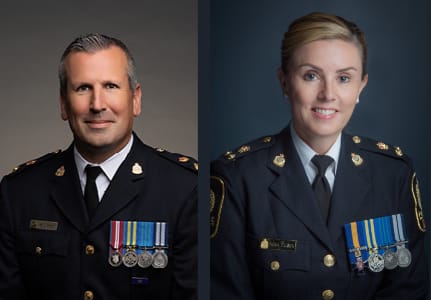
This meeting is the first in-person interaction Nyx and fellow Drug User Liberation Front (DULF) co-founder Jeremy Kalicum had with the VPD’s Phil Heard, then an inspector who has since been promoted to superintendent.
Heard was joined by staff sergeant Jason Chan, and the conversation was cordial — friendly, even — as the DULF co-founders explained their plans to run a compassion club. The club would sell tested heroin, cocaine, and methamphetamine to a small group of members, in an effort to save lives amid a toxic drug crisis that has wracked Vancouver’s Downtown Eastside with an increasingly poisoned supply of street drugs.
A transcript of the conversation is among a stack of documents reviewed by De Facto that paint a picture of how the VPD’s relationship with DULF evolved over time.
Support independent journalism that boldly shines a light on law, justice and rights. Sign up or donate today
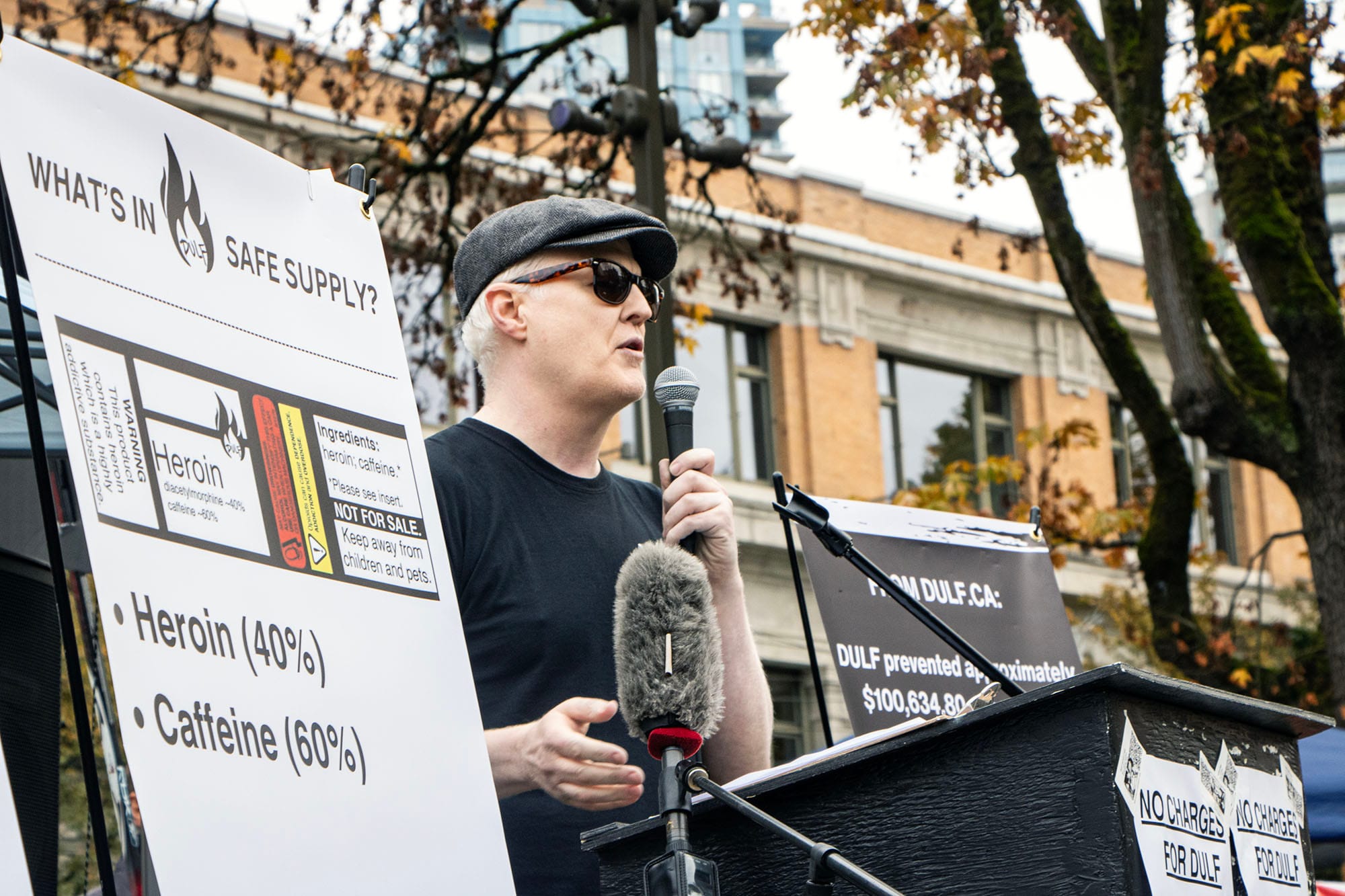
De Facto was granted a court order to view the documents, which were submitted as evidence in Kalicum and Nyx’s criminal trial. However, that order bars publication of any of the documents — except for one set of emails De Facto successfully applied to release.
What started out with a cordial introduction would, just over two years later, take a quick turn. Within only a few months, Heard would go from meeting with Kalicum to approving a criminal investigation into his actions — an investigation that included tracking Nyx’s phone and trying to put a tracking device on Kalicum’s car.
That investigation would end in raids of DULF’s office and of Kalicum and Nyx’s homes, and possession for the purpose of trafficking charges against the two.
Illegal under law, but approved in practice
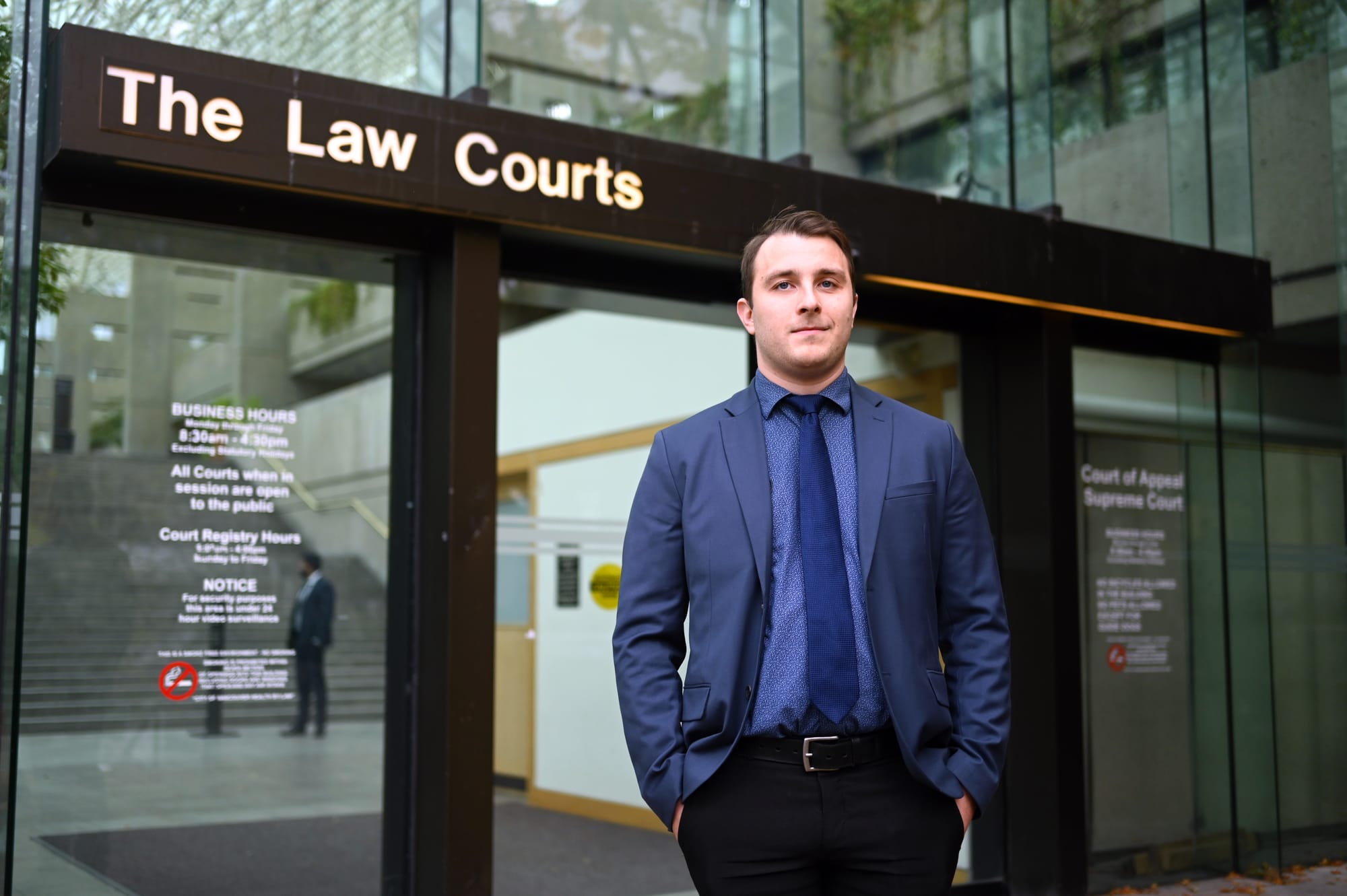
Nyx and Kalicum were found guilty of the charges in November last year. They are currently awaiting a decision in their constitutional challenge that could see the convictions overturned. Justice Catherine Murray is expected to release her decision this Tuesday, Sept. 29, after closing arguments were heard in the summer.
Murray’s decision will hinge on a number of factors.
Closing arguments placed a particular focus on the labyrinthine regulatory approvals processes that, according to DULF’s lawyers, effectively rendered a legal non-medicalized safe supply model impossible.
But DULF’s trial also offers a case study in the fluidity of the law in practice.
[VPD] should have gone to DULF and advised them to shut down, if they thought the public concern was getting too hot.
– Tim Dickson, Drug User Liberation Front's lawyer
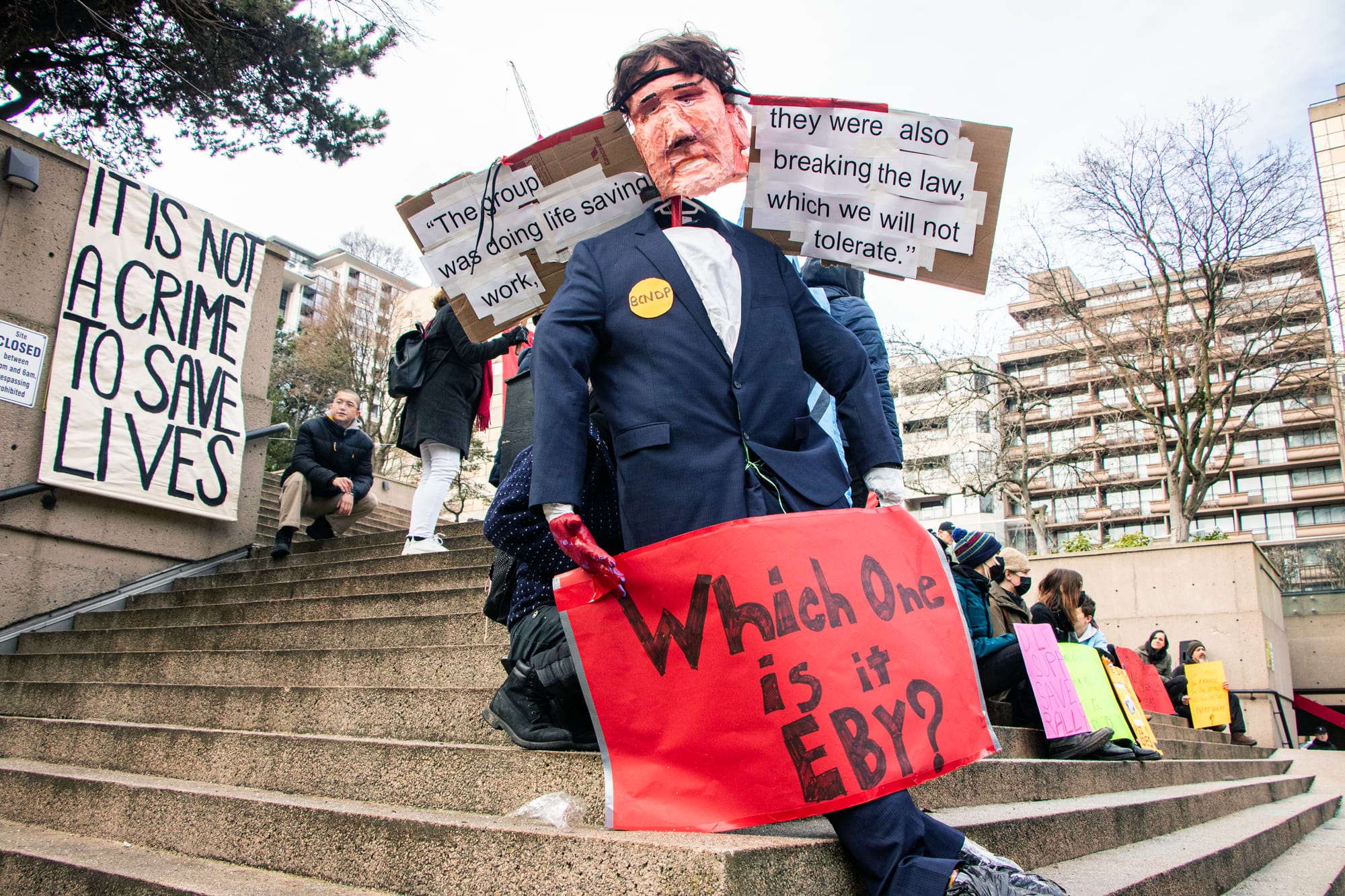
While technically illegal and unsanctioned on paper, DULF’s compassion club operated with the implicit approval of various levels of government — including the VPD — until that approval was swept away amid a shift in political winds.
“This case never should have ended up before you,” DULF lawyer Tim Dickson told the court in closing remarks in the constitutional challenge hearing.
Dickson took aim at the government, which he said failed to take action on multiple calls by experts to expand safe supply programs to go beyond a medicalized model — an approach DULF’s compassion club modelled, with success shown in peer reviewed studies.
He took aim at the BC NDP, which “caved to conservative political pressure” after the local health authority, Vancouver Coastal Health, had previously supported DULF.
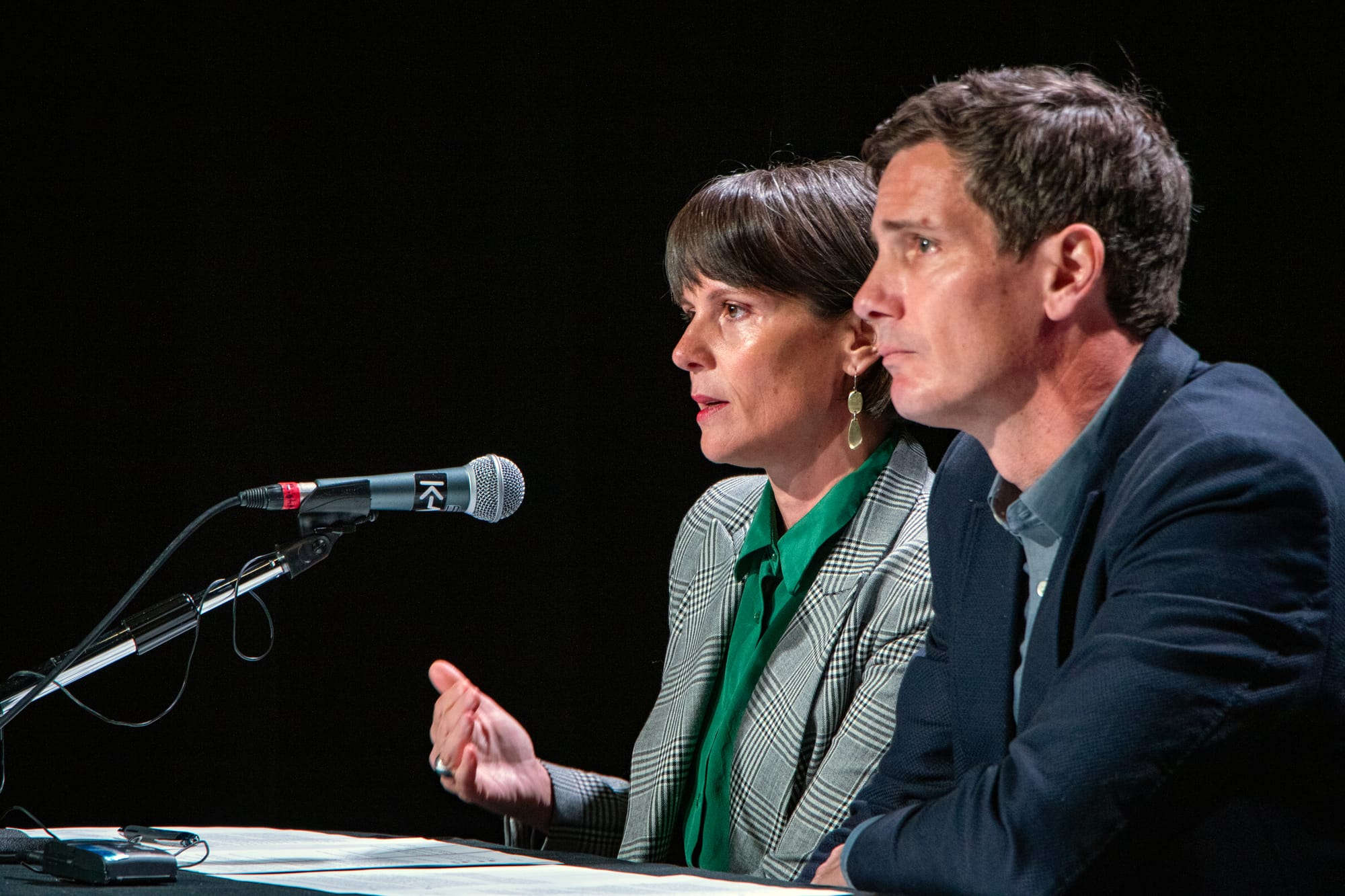
And he shared frustration with the VPD’s decision to pursue criminal charges.
“The Vancouver Police Department, having been briefed by DULF all along about what they were doing and why, should have gone to DULF and advised them to shut down, if they thought the public concern was getting too hot,” Dickson argued.
VPD inspector 'super happy' to work with DULF
“The first I've heard of DULF was after you reached out to the chief’s office,” Heard told Kalicum and Nyx in that 2021 meeting, adding he was enthusiastic about the group when he looked them up.
At the time, DULF was going through an application with Health Canada to operate their compassion club legally, and that offered Heard some relief.
“I'm super happy to hear that you're seeking the section 56 exemption,” Heard told the pair. That section of the Controlled Drugs and Substances Act has exempted from enforcement a number of harm reduction measures, from supervised consumption sites to BC’s limited decriminalization pilot.
“I'm super happy to work with you,” Heard added on getting the s. 56 exemption, going on to reference North America’s first legal supervised consumption site which opened in Vancouver in 2003. “That to me is always the goal, the answer. The gold standard is Insite. Like, can we do this legally?”
I'm happy to work with you at the backend, advocate for it.
– Phil Heard, VPD inspector (now superintendent)
That exemption application, however, was ultimately denied by Health Canada — a decision that is the subject of a judicial review that has itself been awaiting a decision since hearings closed in spring 2024.
Without that approval, Heard offered some caution.
“Even if I'm like, ‘I get this and I'm cool with it,’ … it's always really hard for us to say this is gonna be your experience with the VPD, ’cause I can’t promise that,” Heard told Nyx and Kalicum.
“Each police officer has discretion.”
Heard told the pair that that even applies to officers working under him. “I can tell them, ‘Hey, this isn't my priority,’” he said — but he couldn’t shut those officers down if they decided to pursue charges against the two.
And he noted that many officers aren’t particularly sympathetic to DULF’s work.
“There's a lotta conservative cops,” Heard told them. “Would you ever get the VPD to be like, ‘We support this,’ full stop? The only way you'd probably get that is if it was all legal, like Health Canada signed off on it. I'm happy to work with you at the backend, advocate for it.”
He suggested they keep a relatively low profile, while acknowledging the tension between DULF’s public education goals and concerns that too much attention could spark a backlash against DULF and push the VPD to investigate them.
“All of a sudden that falls back on the police. And it's like, ‘Hey, cops, you guys better investigate these people,’ and then that creates issues. ’Cause we are duty-bound when we get complaints to do something,” he said.
“We can't just go like, ‘Yeah, it's cool. We know Jeremy, it's all good.’”
The relationship ‘dwindled’
Heard’s relationship with DULF would remain cordial beyond 2021 — and it wasn’t just Heard. The court heard in the trial that then-deputy chief Fiona Wilson also had positive interactions with Kalicum, according to The Tyee.
But by mid-2023, as harm reduction was facing a backlash led by conservative politicians, a distance had started to form.
“I feel that our connection to the VPD has dwindled over the past year and I want to make efforts to maintain relations to ensure that what we do is contributing to a better and safer Vancouver for everyone,” Kalicum wrote to Heard on May 18 that year.
Five days earlier, Kalicum had reached out to try to re-establish their connection and talk about potentially expanding DULF’s operations.
I feel that our connection to the VPD has dwindled over the past year and I want to make efforts to maintain relations
– Jeremy Kalicum, Drug User Liberation Front
“I just wanted to check in and see how things were going on the enforcement side of things,” wrote Kalicum, noting DULF’s compassion club had been showing “some promising preliminary results.”
The two sent a handful of emails back and forth to organize a meeting.
“I’m happy to take you for a coffee,” Heard told Kalicum on May 23.
The details of their meeting aren’t clear, but Kalicum brought along a University of BC chemistry professor who’d been helping with drug checking for DULF’s compassion club.
Just four months later, Heard would notify sergeant Mike Cheah, the lead investigator on the DULF file, that he was recommending Wilson approve the investigation plan.
And in October 2023, the VPD raided Kalicum’s and Nyx’s homes, as well as DULF’s office.
Police pushed prosecutors to approve charges
While Dickson argued to the court that the VPD should have simply told DULF to shut down rather than pursuing charges, an Oct. 10, 2023 email shows the VPD had to push for prosecutors to approve charges.
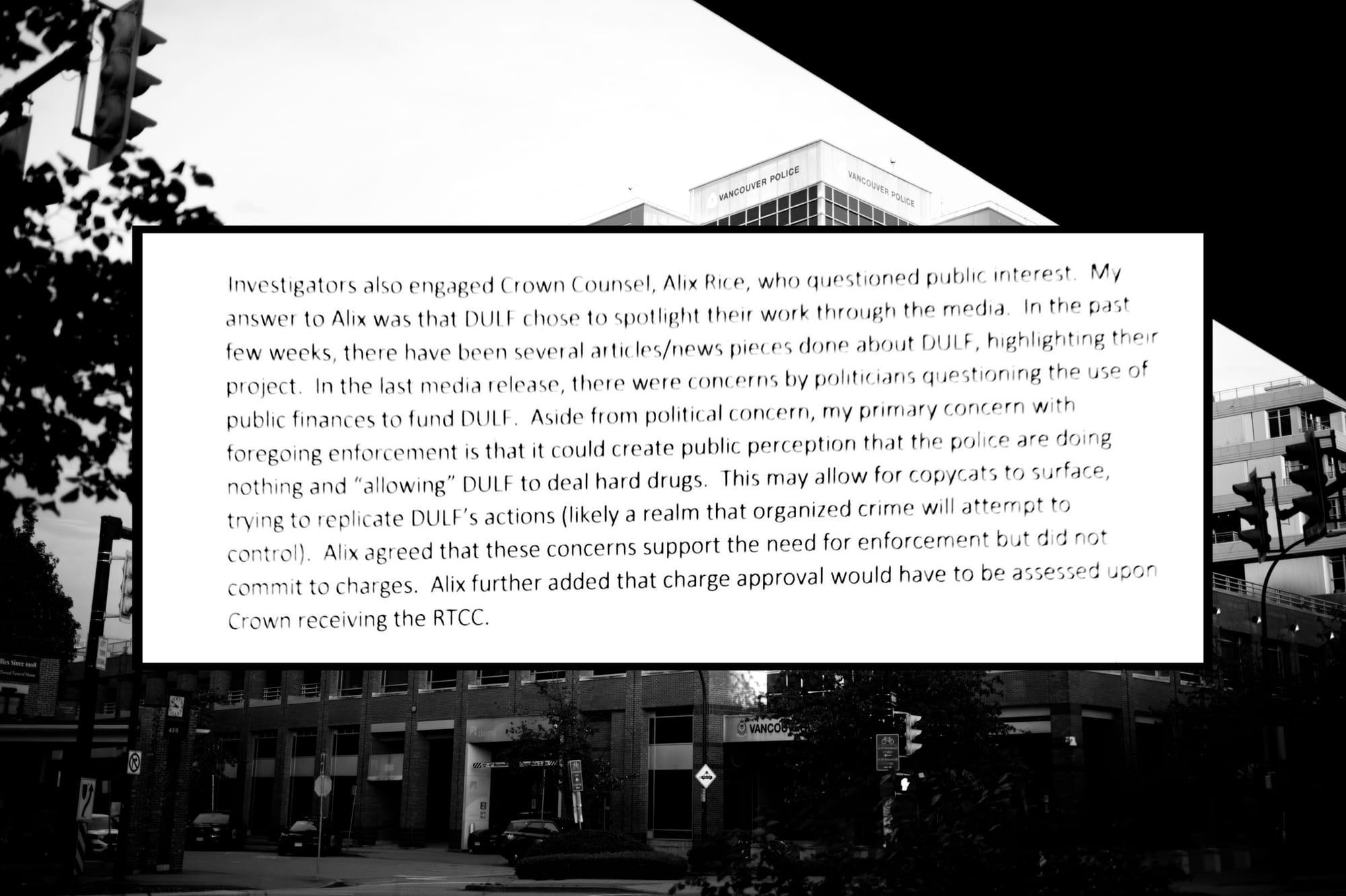
In an update about the investigation to Heard and Chan, the other officer in the 2021 meeting with DULF, Cheah noted crown prosecutor Alix Rice questioned the public interest in charging Nyx and Kalicum.
“My answer to Alix was that DULF chose to spotlight their work through the media. In the past few weeks, there have been several articles/news pieces done about DULF, highlighting their project,” Cheah wrote.
“In the last media release, there were concerns by politicians questioning the use of public finances to fund DULF. Aside from political concern, my primary concern with forgoing enforcement is that it could create public perception that the police are doing nothing and ‘allowing’ DULF to deal hard drugs.”
This argument references a September 2023 article in The Economist titled ‘The drug dealers leading a public-health revolution,’ as well as former BC United MLA and current CentreBC leader Elenore Sturko who led the charge in calling for an audit of DULF’s funding.
With no known overdoses among DULF’s membership, the compassion club had the support of many doctors and researchers, including BC’s former chief coroner Lisa Lapointe. At a political level, the project drew significant criticism from some powerful players, including federal Conservative Party leader Pierre Poilievre.
This backlash was followed by the BC government asking the Vancouver Coastal Health authority to end DULF’s funding and the lease on their office.
VPD then raided this office and arrested Nyx and Kalicum six days before DULF was to cease operations — a move that was celebrated by Poilievre.
Thank you to the VPD for enforcing the law against this drug trafficking organization which has been allowed to freely operate because of the normalization of dangerous drugs by the Liberal-NDP coalition. https://t.co/wEixzHSHFL
— Pierre Poilievre (@PierrePoilievre) October 27, 2023
In his update, Cheah suggested that not pursuing enforcement could “allow for copycats to surface, trying to replicate DULF's actions (likely a realm that organized crime will attempt to control).”
He wrote that Rice “agreed that these concerns support the need for enforcement but did not commit to charges.”
Seeking higher charges
After superintendent Lisa Byrne was forwarded a summary of that update from Chan, she asked if there was “any value in bumping suspected buyers to get an ‘in.’”
While it doesn’t appear that route was followed, documents reveal the lengths the police force went to try to get more serious charges approved against the two.
Kalicum and Nyx were charged with, and ultimately convicted of, possession for the purpose of trafficking. But when Wilson approved the investigation plan, she included a $1,000 budget for undercover cops to try to buy drugs from them — a move which investigators hoped could get actual drug trafficking charges approved.
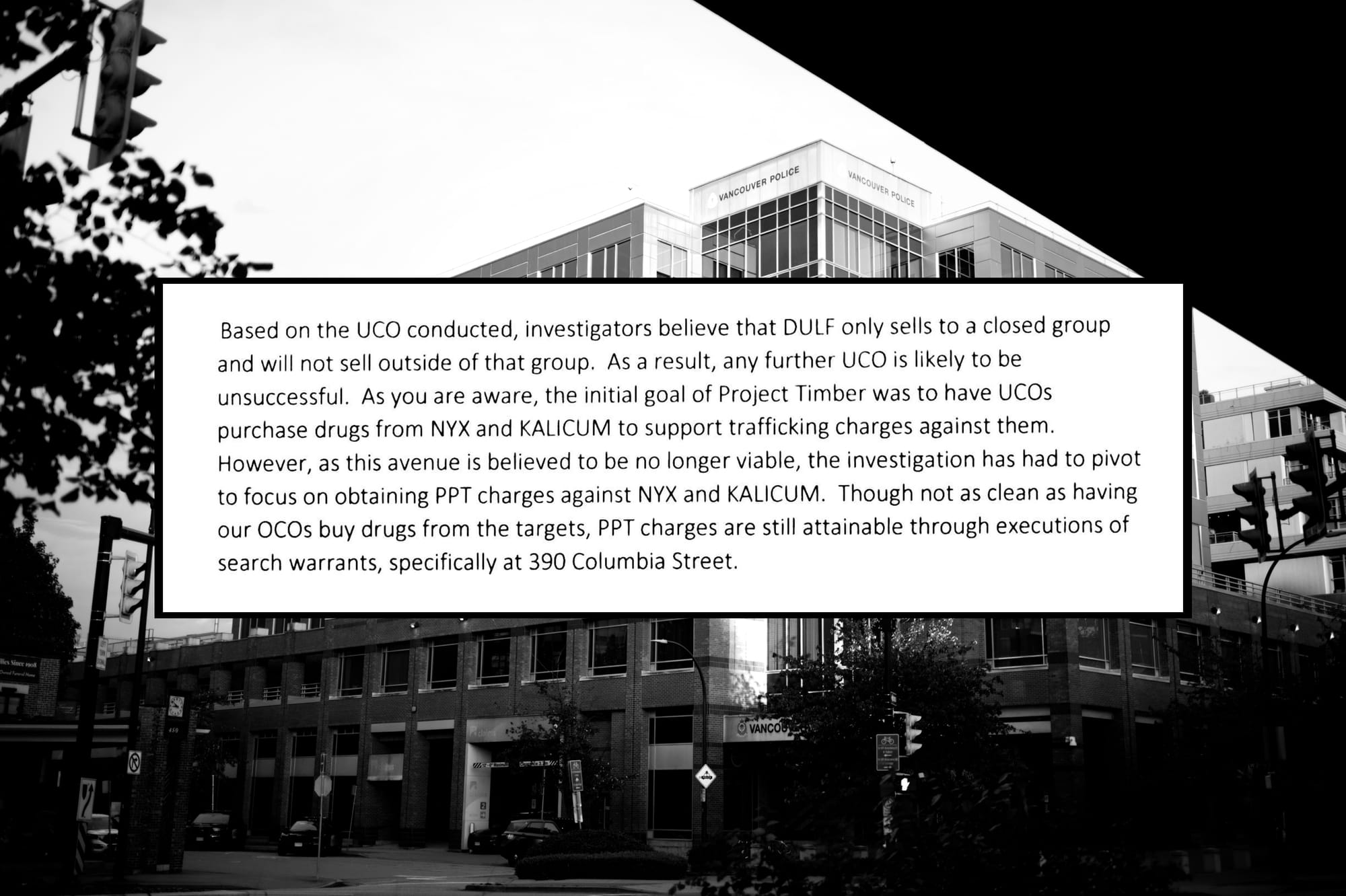
Possession for the purpose of trafficking and drug trafficking are similar charges, and the penalties outlined in the Controlled Drugs and Substances Act are the same, but the latter tends to result in harsher sentences.
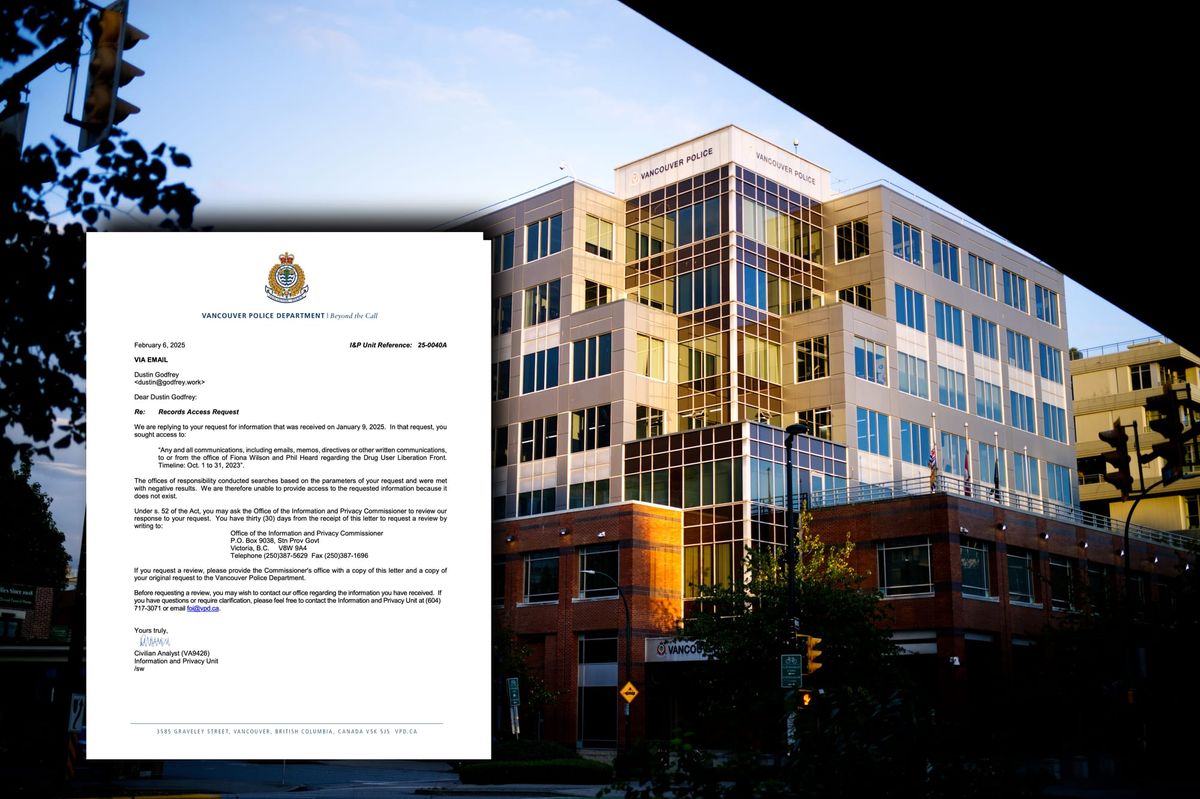
The same day Heard gave the operation his approval, the VPD was granted a warrant to enter the DULF compassion club space “as many times as necessary” for two months to do covert surveillance. At the same time, they were denied a warrant to put a tracking device on Kalicum’s car.
In an information to obtain (ITO), the affidavit sworn by police to get warrants, detective constable Peter Bowater detailed the surveillance conducted on Nyx, Kalicum, and the DULF compassion club location in the Downtown Eastside up to that point.

Investigators spent hours per day on Sept. 13-15 and 19-22 watching Kalicum and Nyx come and go from the clubhouse and their homes, as well as watching others coming and going from the clubhouse.
Bowater claimed the warrants were necessary to catch Nyx and Kalicum in the act of selling drugs, noting he believed they had “insulated their activities” to the DTES compassion club space “to the point that engagements from outside of the business will not yield any evidence.”
Undercover cops try — and fail — to buy drugs
But undercover attempts to access the compassion club’s space proved unsuccessful — as did attempts to buy drugs from DULF.
According to an investigation log, investigators followed two scenarios: on the one hand, posing as potential clients and trying to buy drugs from DULF, and on the other, surveilling Nyx “to obtain lifestyle [information] to assist with possible UC [undercover] scenario in future.”
The former was entirely unsuccessful.
On Sept. 27, an undercover officer knocked on the compassion club’s door and got no answer. An unidentified woman outside told the officer the club was a “closed research program” and “indicated that she couldn't talk about it.”
That same day, the undercover officers spoke to Kalicum outside the location and “inquired about the purchase of ‘clean’ drugs,” according to the investigation log. Kalicum told the officer they were only working with a closed group and turned down the possibility of getting onto a waitlist but suggested they buy from the dark web.
Surveillance at home and on the go
When it came to surveilling Nyx, the details were scant.
“Goals of the surveillance are to locate and monitor the activities of Eris Nyx, document any meetings and locations attended, as well as obtain video. Investigators are also seeking to observe fob-ins at [Nyx’s home],” the investigation log notes on Oct. 5, as investigators came to understand that buying drugs was an unlikely option.
“Investigators were concerned [about] members of DULF openly selling drugs to the public. Investigators are satisfied there is some sort of screening in place and don't want to pursue another scenario.”
The surveillance shows Nyx coming to and from her home, the DULF compassion club space, and a location believed to be an administrative office for DULF, but little more.
On one day, investigators only note that they “deployed surveillance on Nyx to determine lifestyle on weekend.”
The result of that surveillance was a brief line: “Nyx observed as she left her residence on a bicycle, VCB.” It is unclear what the acronym refers to.
Support independent journalism that boldly shines a light on law, justice and rights. Sign up or donate today
A few days later, officers decided to get a tracker for Nyx’s phone, “as it proved difficult to surveil Nyx when she rides a bicycle in the downtown area” — a warrant that was ultimately approved by a judge.
Goals of the surveillance are to locate and monitor the activities of Eris Nyx, document any meetings and locations attended, as well as obtain video.
– VPD investigation log, Oct. 5, 2023
No details of surveillance from that tracker are included in the investigation log.
Nearly two weeks after the investigation log’s entry on the phone tracker, police raided the DULF compassion club, and the homes of Nyx and Kalicum.
They seized laptops, phones and drugs — and Kalicum’s car, which officers considered passing to the asset forfeiture unit, according to the investigation log. They ultimately decided against that route and returned the car to Kalicum.
One day before the raid, Kalicum would send his last email in evidence to Heard, to reintroduce the UBC chemistry professor he’d brought to the May 2023 meeting with Heard.
In the email, which got no response from Heard, Kalicum outlines a drug-checking service being worked on at UBC, which he believed could be of use to the VPD.
“Anyways, for what it's worth you both have extremely high regards in my books,” Kalicum wrote in closing, “and I hope this will be a fruitful connection.”
Dustin Godfrey
Dustin (they/them) is a De Facto member and a reporter based in Vancouver, BC, on Sḵwx̱wú7mesh, xʷməθkʷəy̓əm, and səlilwətaɬ territories. Their work has also appeared in The Guardian, The Tyee, The Globe and Mail, The Maple, Filter Magazine and an independent newsletter where they’ve focused on policing, drug policy, health and housing. They've won awards from the Jack Webster Foundation, Canadian Community Newspaper Association, BC and Yukon Community NewsMedia Association. Read their reporting