Transparency advocates on police ‘culture of confidentiality and secrecy’
A conversation with BC Freedom of Information and Privacy Association's leaders about Vancouver top cops' claims to have no emails about Drug User Liberation Front before they raided — emails we later obtained in court.


This week, the co-founders of a compassion club arrested by Vancouver police three years ago are making their final arguments as they challenge their convictions.
The harm-reduction activists' drug trafficking-related charges stemmed from a 2023 raid, which followed weeks of intense media and political outcry about the Drug User Liberation Front (DULF).
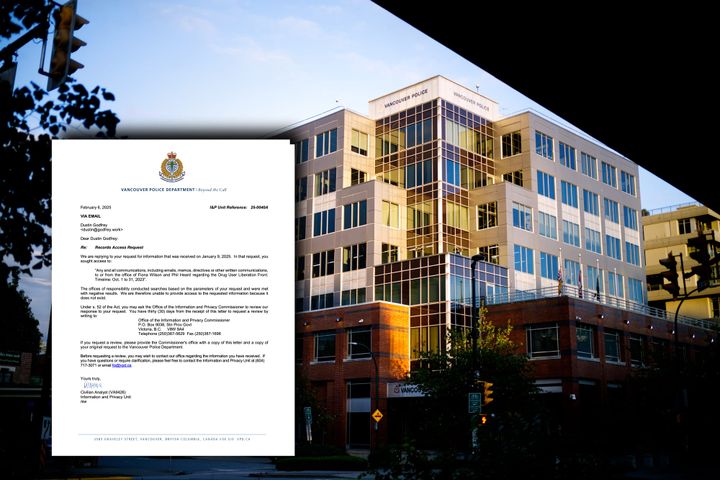
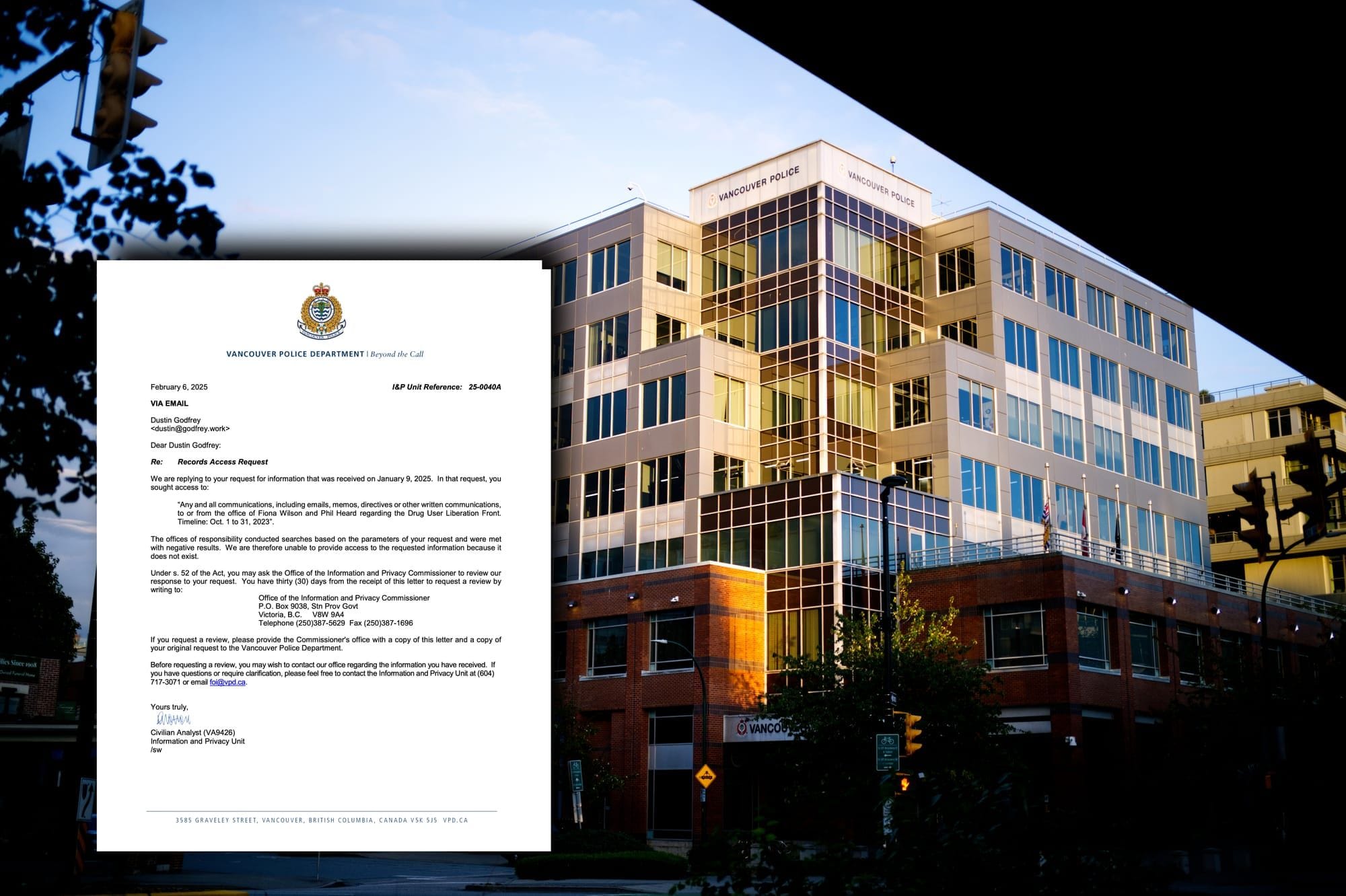
Yet when De Facto asked the Vancouver Police Department (VPD) for “any and all communications … to or from” several top cops about DULF the month of the raid, it insisted no such emails were ever sent or received.
In fact, emails to two senior officers were among the evidence in DULF’s court case.

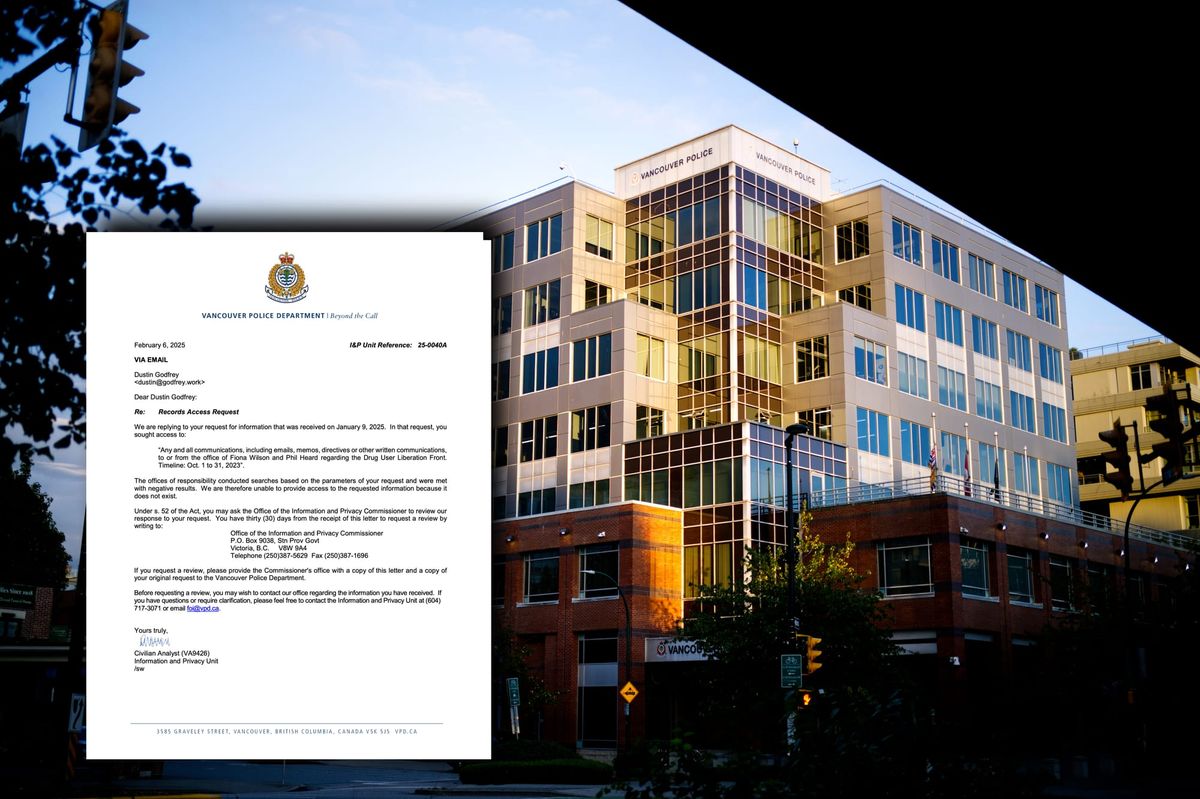
De Facto’s Dustin Godfrey filed a formal complaint to BC’s Office of the Information and Privacy Commissioner (OIPC), and will continue to report on this case.
Godfrey spoke to two government transparency experts about the discrepancy:
• Jason Woywada, executive director of the BC Freedom of Information and Privacy Association (FIPA), and
• Mike Larsen, FIPA's president and a Kwantlen Polytechnic University criminologist.
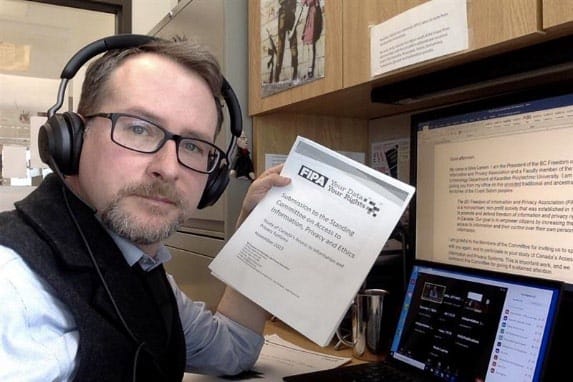

Freedom of Information and Privacy Association president Mike Larsen (left), and executive director Jason Woywada. Photos courtesy FIPA
They discussed why freedom-of-information matters, what sets police apart in the world of transparency — and what needs to change to hold powerful public agencies accountable.
This interview has been edited for clarity and length.
Dustin Godfrey: When I filed this FOI request to the VPD, and got a response back, it just always sat weird with me that these two senior-ranking officials had zero emails regarding the Drug User Liberation Front in the month the raid happened and they were arrested. But in the DULF trial evidence, I happened to see emails to and from both of the officers. Is there any explanation that you can kind of think of?
Mike Larsen: In addition to my work with FIPA, I'm a professor of criminology at Kwantlen Polytechnic University, and spend a good bit of time kind of thinking about police accountability.
There's plenty of evidence in recent history of police organizations using non-official devices and accounts for purposes of communication.
This has been a big issue in Ontario, it's been an issue in BC; there are major investigations and court cases that have involved the use of Signal and WhatsApp and other things for what ostensibly are public communications — and really ought to be taking place through appropriate channels.
I would also say there's a lot of context for inadequate search of records responsive to [an FOI] request and the duty to assist.
There have been OIPC investigations of the failure to conduct adequate searches and to document the search process.
So it wasn't surprising, unfortunately, when I saw evidence that there was a failure to identify records that were clearly responsive to your request. Because there's much precedent for that.
 De Facto Journalism Co-op
Jason Woywada: We've consistently seen in our research that there are deficiencies in public bodies meeting their duty to assist, and undertaking every reasonable effort to assist clients.
What it results in is a reduction in trust from the public in public bodies. Because every time we as the public see this type of discrepancy, it raises more questions than it answers.
It leads to a lot of conspiratorial thinking potentially, because you start wondering whether there was mal intent or just incompetence. Neither of those two possibilities is good from a public accountability perspective.

So if there was mal intent — and they withheld the records intentionally — well, that's a problem. And if they couldn't find the records, well, that's a problem.
So neither of these scenarios gives us a great deal of faith in what's taking place there, or that they're treating records management or information management appropriately within the organization.
We need to make sure that this information is readily available when it's requested from the public.
"It results in ... a reduction in trust from the public in public bodies. Because every time we as the public see this type of discrepancy, it raises more questions than it answers."
– Jason Woywada, BC Freedom of Information and Privacy Association (FIPA)
Mike Larsen: OIPC has been really alive to the failure of organizations — including police — to conduct adequate searches. There is a big problem with officials and police organizations using non-standard communications devices, which completely circumvents the duty to document the work that they do.
Not to say that that's the case here, but there have been other examples of situations where there's a string of communications — like an ongoing, running chat — that if you were to conduct a standard FOI to get access to those records, you would find nothing.
Because they're all taking place on unapproved devices and unapproved channels.
[In the DULF case], there's evidence that there was a failure to identify responsive records. I think it's particularly interesting that it is a contentious issue, isn't it?
This isn't an issue of routine communication; this is about a case that they've already flagged to be a hot-button issue.
Jason Woywada: Precisely because it's a police organization, it's more concerning.
Because when you're looking at elements like chain-of-custody, and what is expected in police investigations and legal criminal matters, the standard and expectation from the public is they're maintaining the highest standards. That's what we expect.
This discrepancy [in police email records] does raise a lot of questions — what standard are they meeting? How are they setting up their police officers to succeed in meeting that standard?
 De Facto Journalism Co-op
It leads to the question about whether or not VPD needs to go under greater scrutiny for their information management.
Because otherwise, you start running into a lot of questions about how are they meeting their chain-of-custody in the control of records, if they can't meet a basic FOI request?
How are they making sure that they're meeting the legal tests in court? It again speaks to the element of trust in society, in terms of how we trust public bodies — and how they're supposed to act to engender trust from us, as a public, in them.

One of the officers in my request actually has gone on to become the chief of the Victoria Police Department. Is it concerning that this person is now in such a high leadership position?
Mike Larsen: There aren't that many municipal police organizations of any size within British Columbia, because quite a bit of policing is done by RCMP.
The literature is clear that there is a cultural problem with transparency in policing writ large, and this is not a new thing, nor is it specific to a particular jurisdiction. There is a willful disregard for clarity, transparency, and the public's right to know.
It's a long-standing issue. Again, I have no idea what informed the lack of response in this case. But as a criminologist, it doesn't surprise me when I hear about organizations circumventing transparency. Unfortunately, it is a cultural problem.
"There is a cultural problem with transparency in policing writ large ... a willful disregard for clarity, transparency, and the public's right to know."
– Mike Larsen, FIPA
Jason Woywada: From an organizational-behavior perspective, the priorities of an organization are set from the top, and the way they are acted upon is set from the top.
So if the leadership doesn't make information management a priority, the organization won't. So it is concerning.
Leaders have every opportunity to make other things a priority in their organization, other than their core mandate.
I think leaders recognize the importance of doing routine business routinely, and information management is an important part of serving the public.
Those are really important dynamics that cascade into access-to-information and trust from the public.
Do police departments, in particular, tend to be on the worse side for being responsive to FOI requests?
Mike Larsen: This is definitely a common observation. In policing — and security-intelligence agencies as well — you have the kind of mandate of secrecy and confidentiality, and a notion of authority, that goes along with their role.
So you do see more instinctive orientations towards secrecy and information control. That demarks these organizations differently than other public-service types of roles. This is the finding of a lot of research on the topic.
"You have the kind of mandate of secrecy and confidentiality ... You do see more instinctive orientations towards secrecy and information control."
– Mike Larsen, FIPA
But there's also the Occam's Razor aspect of this too: which is simply that there's inadequate searches done — not because of any specific decision to disregard or to conduct poor searches for records, but because of some systemic failures in the way the organization organized its FOI responses, lack of resourcing, lack of commitment to that topic, and the lack of finding aids too.
You shared with us the wording of your FOI request — it's a very common and good request. You said, ‘These are the people, these are the kinds of documents, this is the timeframe I'm interested in, this is the topic.’
A lack of proactive disclosure or lack of proper retention I think leads to this kind of stuff.
I've seen many cases where people have filed requests for review for an inadequate search for records; I've done this. Once there's additional scrutiny, stuff gets found. So that's not unusual.
Jason Woywada: A key point in this is that with great power comes great responsibility. Police have some of the greatest powers to suspend civil liberties in civil society. With that comes a responsibility.
So it's important for them to act appropriately within that, and make sure that they are engendering trust in that process.
What do you think are solutions, if we can't necessarily trust that the officials themselves are going to be forthright about which emails are responsive to an FOI request?
Mike Larsen: There is a huge reliance on the honour system when it comes to the processing of FOIs in BC.
We have found in our recent research that the lack of training, and the lack of resourcing across that system, compound that. People can make honest mistakes; they can conduct bad searches.
When I was first filing FOI requests back in the 2000s, you'd have to go to a subject matter expert who would have some knowledge of the field, and they would go through and try and find responsive records.
With the use of keywords now to search, you're searching for particular strings of things. That is both helpful — because it can find a lot of stuff — but also it really limits the search to what those keywords are.
I'm someone who's deeply skeptical about artificial intelligence for a variety of reasons, but there is a capacity for it to conduct a more fulsome search than perhaps someone could otherwise, given time constraints.

Support independent journalism that boldly shines a light on law, justice and rights. Sign up or donate today
In terms of general solutions, audits, spot checks, and routine drop-ins should be done by management for an organization, not just an external reviewer like OIPC.
If you really take transparency seriously, you should test your own organization to see that it is actually following through on its commitment to transparency.
Conduct some internal audits and reviews; right now, organizations tend to rely on OIPC to do that — so if you're not getting in trouble, then you must be doing it OK. But that doesn't really work.
I would expect to see more robust training reviews and investigations, including of senior personnel within the organization.
"Police have some of the greatest powers to suspend civil liberties in civil society. With that comes a responsibility."
– Jason Woywada, FIPA
Jason Woywada: Access-to-information and record searches are done off of the side of somebody's desk, typically.
That is why I think having information managers embedded in public bodies — who are empowered to have proper span of control — so that they can gain access to records when a request is received.
The ability for them to use AI to search for records is important to avoid those types of keyword traps that Mike is talking about.
A librarian or an archivist or an information manager uses an entire research methodology to find records when they are looking for these things in large repositories.
That is very different from you or I — as you know, ‘tourists’ in that field — looking for those types of records.
So it's important that information managers and their expertise is appropriately identified and leveraged by the organization to find those records, and that they are using every tool at their disposal in order to do that.
That may include AI in those cases, because what AI is enabling in these systems is the ability to do those types of searches faster, more effectively, in order to find some of those records.
Archivists and information managers live and breathe these types of record retrieval things on a regular basis.

You use the words ‘honour system.’ It seems odd to me that we would rely on an honour system for a system of accountability. Isn’t freedom of information inherently about holding people accountable?
Mike Larsen: I agree to a certain extent, but at the same time the entire field of policing is based on the exercise of discretion. There is a huge honour system built into that.
The courts have typically regarded police note-taking as being presumptively truthful. And police use of force is entirely based on discretion as well — with massive flaws and problems with it.
I don't think that FOI stands out as being uniquely based on honour in relation to other exercises of authority by police.
There is a requirement for trust in these kinds of institutions. When we see that eroded — or if we see a breach of trust or a failure to adequately discharge that trust — then it starts to raise some serious questions about the integrity of the organization writ large.
Transparency is an important issue, because it gets to that question of honesty. Even if they missed these files, it accumulates over time — and you get into a position where people actually have an earned distrust in an institution that requires trust to function.
That's a serious problem. That's why I think it's very important for organizations to take transparency seriously.
"If we see a breach of trust or a failure to adequately discharge that trust — then it starts to raise some serious questions about the integrity of the organization writ large."
– Mike Larsen, FIPA
Jason Woywada: Ultimately the court is the stricter accountability setting. So it makes sense that the records released in a court proceeding may vary from what an FOI request will release. Is that ideal? Absolutely not.
But solicitors, the OIPC, and the courts will have access to — and see unredacted — what a member of the public may never see. There are some of these inherent trust dynamics that are meant to be embedded there, that allow for formal review processes.
It takes a long time to build trust on the part of public bodies, and it takes only one or two infractions to reduce it.

In another related FOI request — that I'd submitted to the Public Safety Ministry around the same time — their explanation was, ‘Oh, it was deleted because it was transitory.’ I'm curious about your thoughts on that very vaguely defined term?
Mike Larsen: We're seeing trends in Canada right now — I think Ontario is a good example of this — to treat more and more communications as being transitory, and therefore not retained and subject to FOI.
It is potentially an elastic concept. The standard you need to have, as an organization, is clear guidelines as to how you treat things that are transitory — and how you actually go about archiving.
I have seen many examples of institutions that treat what is ostensibly really important information — correspondence information — as being transitory.
When I first started doing research using access-to-information law, people actually were writing fulsome emails; you would actually have a discussion in an email thread that was the back-and-forth record and documents of decision-making and analysis.
If that was treated as transitory, there are whole swathes of what goes on in public bodies that would simply be off the books, off the records, and out of the archives.
"It takes a long time to build trust on the part of public bodies, and it takes only one or two infractions to reduce it."
– Jason Woywada, FIPA
‘Do you want to meet up next Tuesday?’ or ‘Are we are we getting new supplies in the office cabinet today?’ — these are transitory records. These are things that don't really have too much importance.
But if there's substantive content, we push for a duty to document. That gives greater clarity on what constitutes something that is a record of public interest that needs to be retained.
Organizations can do that on their own. Once they start treating records systematically and archiving them appropriately, it becomes part of routine practice.
Jason Woywada: There's an increasing and healthy tension in this area right now.
When the acts were originally drafted and contemplated, there was never the desire to put every public servant under surveillance; that wasn't the intention of FOI.
It was to make sure the appropriate records were released at the appropriate time for the appropriate reasons. Should decision-making discussions and meetings, and the records of those meetings, be available to the public? Absolutely.
 De Facto Journalism Co-op
As the technology evolves — and as our business practices and activities in public bodies evolve — there should be a healthy discussion in terms of trying to release more information on a regular basis rather than less.
What's happening in Ontario, and some of the actions of governments trying to act in a more secretive manner, is not going to engender trust.
A lot of public bodies are making the wrong steps and are becoming more secretive and more confidential.
That is tanking the public's trust in what they are doing.
The only way to solve that is to increase their transparency and increase the amount of information they are putting out to fill the vacuum.
Because in an information vacuum, mis-, dis-, and mal-information thrives. And that's where conspiracy thrives, and that's a real problem in current civil society.
"A lot of public bodies are making the wrong steps and are becoming more secretive and more confidential. That is tanking the public's trust."
– Jason Woywada, FIPA
Looking back at the ‘triple-delete scandal,’ BC’s Government Information Act explicitly removed penalties for violating that. Have your thoughts on that evolved since 2016?
Mike Larsen: The act was in many ways a response to the ‘triple-delete scandal’ and other kinds of political interference and failures to properly document and retrieve records for FOI.
FIPA was the lead organization calling for a legislative duty to document. And we supported there being penalties, particularly for deliberate interference, as we saw in the ‘triple-delete scandal’ — that was not an accidental situation there.

The major consequences for failing to discharge responsibilities under transparency law in British Columbia right now, for public bodies, are mostly matters of public reputation.
The OIPC can order the release of documents, the OIPC can find organizations to be in error or in breach of their duties — that's a black eye that doesn't look good, but there are few other mechanisms to actually respond to that.
Quite often, investigations on information-and-privacy breaches or failures are basically ‘Here's what went wrong, don't do it again.’ There aren't that many sticks alongside the carrots in the arsenal of regulators who govern this kind of stuff.
"There aren't that many sticks alongside the carrots in the arsenal of regulators."
– Mike Larsen, FIPA
I don't think that having a penalty-based model is the best way to go, just writ large. I think the best way to go is to have an institutional culture of transparency.
But the fact remains that it's possible for organizations to not adequately respond to their obligations under the Freedom of Information and Protection of Privacy Act — and to face few meaningful consequences for it.
Jason Woywada: I think administrative monetary penalties are never a good idea in public bodies, because you're robbing Peter to pay Paul; it's all coming from one general-revenue fund.
We've been much stronger in advocating for greater powers for the [information and privacy] commissioner to compel public bodies to comply — in the same way that the auditor-general has the ability to compel public bodies to comply.
Failure to appropriately manage information should be a disciplinary proceeding for staff and managers in public bodies, and should be grounds for progressive discipline or terms for dismissal. That would go a long way to fixing some of this.
It creates a systemic culture of confidentiality and secrecy that doesn't serve the public interest.

Editor: David P. Ball

Dustin Godfrey
Dustin (they/them) is a De Facto member and a reporter based in Vancouver, BC, on Sḵwx̱wú7mesh, xʷməθkʷəy̓əm, and səlilwətaɬ territories. Their work has also appeared in The Guardian, The Tyee, The Globe and Mail, The Maple, Filter Magazine and an independent newsletter where they’ve focused on policing, drug policy, health and housing. They've won awards from the Jack Webster Foundation, Canadian Community Newspaper Association, BC and Yukon Community NewsMedia Association. Read their reporting